Head-to-head
Uphold vs Coinbase: Spreads, Coins and Safety Compared
For a straightforward bitcoin purchase, Coinbase is usually the cheaper and more widely licensed choice, as long as you use its Advanced screen: Uphold prices bitcoin with a typical spread of 2.05% to 2.2%, which is about $21 on a $1,000 buy, while Coinbase Advanced charges a maker or taker fee with no spread. Uphold's appeal is breadth: crypto, stocks and precious metals in one account, with direct conversion between them. Look elsewhere if you live in New York, which is not on Uphold's US licence list, or in Canada, and skip its altcoin trades if cost matters, because its published spreads there reach 3.8%.
Uphold pays us nothing; Coinbase and Kraken links on this page are affiliate links. Figures come from each company's own fee and legal pages, read on 9 October 2026.
The short verdict
Both are custodial platforms that hold your coins for you, both let you send crypto out to your own wallet, and both are licensed US money transmitters. The difference is in how they price and what they sell. Uphold quotes one all-in price with the spread built in and no separate trading fee. Coinbase splits its pricing: a simple screen with a spread and a fee, and an Advanced screen with an order book and a small fee and no spread.
If you are buying bitcoin or ether and nothing else, the order book wins on cost. If you want to hold crypto, US stocks and gold in one balance and move between them in a single step, Uphold does something Coinbase does not, and its spread is the price of that convenience.
Cost on identical buys, dated
Uphold publishes typical spreads by asset class, and on its US fee page the spread is the whole charge for trading:
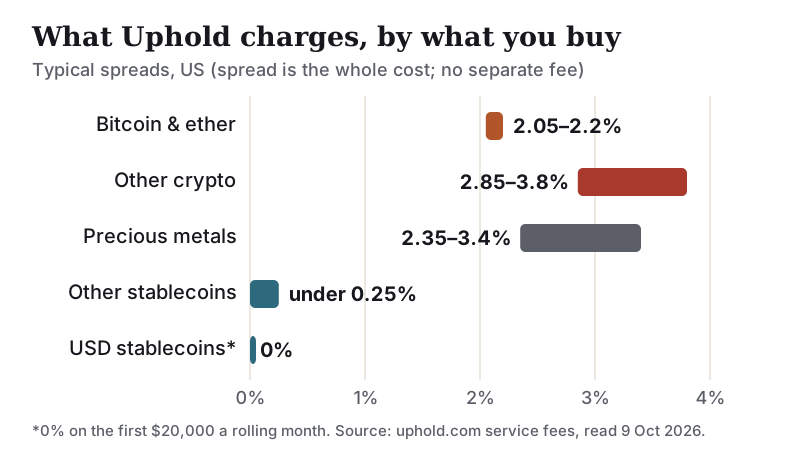
On a $100 bitcoin buy, a 2.05%–2.2% spread costs about $2.05 to $2.20. On $1,000, about $20.50 to $22.00. A $1,000 altcoin buy at 2.85%–3.8% costs $28.50 to $38.00. Uphold also says that when you convert between an altcoin and a stablecoin, the higher of the two rates applies. USD stablecoins are the exception: conversions are free on the first $20,000 a rolling month, as long as the coin trades within 0.2% of $1.
Coinbase does not publish one number for its simple buy. Its disclosure says a simple trade includes a spread plus a Coinbase fee that depends on payment method, size, asset and location, all shown on the preview screen. On Coinbase Advanced, there is no spread; you pay a volume-tiered maker or taker fee, and Coinbase advertises maker fees as low as 0.0% at its top tiers. The only dated side-by-side we found comes from Robinhood's own quote table on 18 September 2026, which put Coinbase Advanced just 0.11% behind Robinhood's quote for a $10 ETH purchase and Coinbase's simple screen 1.86% behind. Even allowing for that table's source, Advanced sits well below Uphold's 2%-plus spread on bitcoin.
Coins and products
On its US homepage Uphold advertises 300-plus cryptocurrencies, more than 4,000 stocks and ETFs, precious metals and 27 fiat currencies under one login. You can convert directly from one to another, for example from bitcoin to gold, in one step. Stock trading runs through Uphold Securities, with some accounts offered by Atomic Brokerage, both FINRA and SIPC members; Cross River Bank issues the Uphold card. Uphold notes that its multi-asset, staking and borrowing features are limited to certain places, so check what your state or country can use.
Coinbase is a crypto exchange that has broadened. By December 2025 its annual report listed stocks, commodity futures, perpetual futures and prediction markets alongside spot crypto. Precious metals are not among the products that report lists. For buying and holding mainstream coins, both platforms cover the ground; for a mixed crypto-stocks-metals portfolio in one place, Uphold has the wider shelf.
Staking costs differ more than most comparisons show. Uphold keeps 50% of rewards on flexible staking, and 35% on boosted staking from 15 October 2026. Coinbase's standard commission is 35% on ETH, SOL and several other assets, with lower rates for paying Coinbase One members.
Safety and transparency
Neither platform is a bank, and crypto held on either is not FDIC-insured. Uphold says it is "always fully reserved" and publishes its assets and liabilities in real time on a transparency page. That is a self-reported figure, not an audit. Coinbase, as a US-listed public company, files audited annual reports. Its 2025 report says it holds customer assets one-to-one and aims to keep no more than 2% in hot wallets, but also warns that its custody terms are untested in a bankruptcy court, where customers could rank as unsecured creditors.
Coinbase's record includes a May 2025 insider data theft, in which bribed support contractors took customer data used later in impersonation scams. Its annual report says it paid $311.2 million in cash in 2025 over the incident. The SEC dismissed its civil case against Coinbase on 27 February 2025.
The practical point is the same for both: a custodial balance carries platform risk. If you are holding for the long term, withdraw to a wallet you control.
Availability in the US, UK, Canada and EU
Uphold's US regulators page lists money-transmitter licences in more than 40 states, plus DC and Puerto Rico. That list omits New York, and California's licence under the state's new digital-asset law is marked as pending. Coinbase holds a New York BitLicense dating from January 2017.
Outside the US the gap widens. In the UK, Uphold Europe is registered with the FCA for anti-money-laundering purposes only, and its own footer says its cryptoasset services are unregulated. Canadians are largely shut out: Uphold's Canadian arm pulled its registration application in certain provinces, so Canadian residents can no longer get its registrable services. In the EU, Coinbase Luxembourg is MiCA-authorised since 20 June 2025; we could not confirm a MiCA authorisation for Uphold.
| Uphold | Coinbase | |
|---|---|---|
| How you pay to trade | Spread only (BTC/ETH 2.05%–2.2%) | Simple: spread + fee. Advanced: maker/taker, no spread |
| Assets | 300+ crypto, 4,000+ stocks/ETFs, metals | Crypto; stocks and derivatives added in 2025 |
| New York | Not on its licence list | BitLicense (Jan 2017) |
| EU | MiCA status not confirmed | MiCA-authorised (Jun 2025) |
| Reserves | Self-reported real-time transparency page | Audited public-company filings |
| Share of staking rewards kept | Flexible 50%; boosted 35% (from 15 Oct 2026) | 35% standard |
Uphold vs Kraken in brief
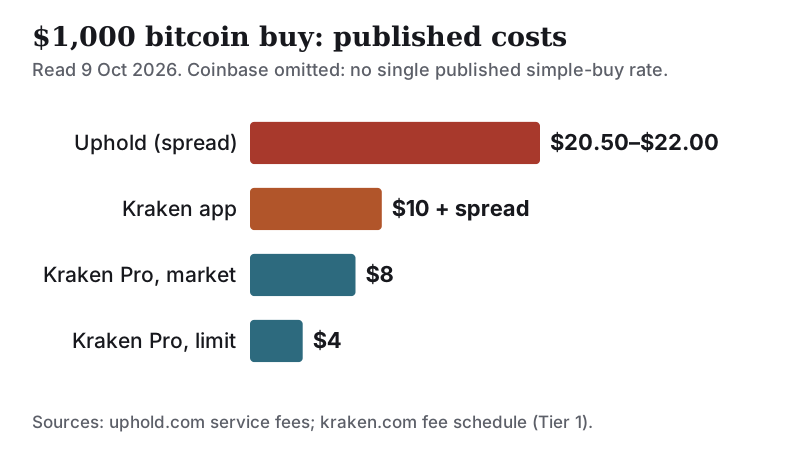
Kraken is the other common comparison. On a $1,000 bitcoin buy, Uphold's typical spread costs $20.50 to $22.00. Kraken's simple app charges a 1% fee, $10, plus a spread it does not publish; Kraken Pro charges 0.80% for a market order and 0.40% for a limit order at its entry tier, $8 or $4. Kraken is unavailable to New York and Maine residents. For bitcoin alone, Kraken Pro is far cheaper than Uphold; Uphold keeps its edge only for multi-asset conversions.
Affiliate link. We may earn a commission if you sign up — it never decides who wins a comparison. Check current terms and eligibility in your country.
Who should pick Coinbase
Pick Coinbase if you mainly buy bitcoin, ether or other mainstream coins, live in New York or the EU, or want a platform with audited public filings. Learn the Advanced screen first; its no-spread order book is where Coinbase beats Uphold on cost. If you are weighing other exchanges on the same basis, our crypto exchange comparison explains the method, and Coinbase vs Kraken covers the closest rival.
Affiliate link. We may earn a commission if you sign up — it never decides who wins a comparison. Check current terms and eligibility in your country.
Who should pick Uphold
Pick Uphold if you genuinely want crypto, US stocks and precious metals in one balance and value converting between them in a single step, and your state is on its licence list. Keep trades to bitcoin, ether and USD stablecoins where its spreads are lowest, and check the quoted price before you confirm.
Edge cases worth checking
- You trade altcoins often. Uphold's 2.85%–3.8% spreads add up fast; an order-book exchange is usually cheaper.
- You hold USD stablecoins. Uphold's 0% conversion covers only the first $20,000 a rolling month.
- You are in California. Uphold's licence under the state's new crypto law shows as pending; check before funding.
- You stake. Uphold's 50% flexible-staking commission halves your rewards. Compare the net rate on each platform.
- You receive a call about your account. A genuine Uphold or Coinbase agent will never tell you to shift funds into a "safe" wallet. Hang up and contact them through the app.
Crypto values swing hard, and you could lose the full amount you put in. This page compares published terms; it is not financial or investment advice.
Uphold vs Coinbase: quick answers
Is Uphold cheaper than Coinbase?
Does Uphold charge fees or just spreads?
Can I use Uphold in New York?
Uphold vs Kraken: which is cheaper for bitcoin?
Is Uphold safe?
Still deciding? See how to compare crypto exchanges for the full method, or browse every head-to-head. None of this is financial advice.