Head-to-head
Coinbase vs Robinhood for Crypto (2026): Fees, Coins, Withdrawals
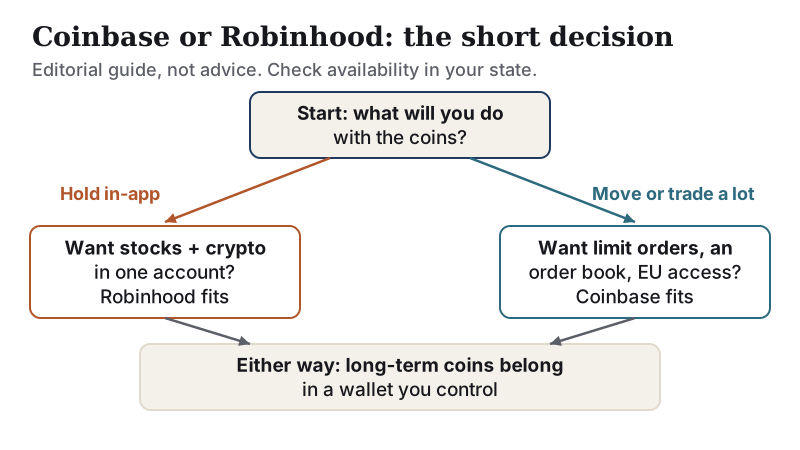
For most people asking "Coinbase vs Robinhood", the answer turns on one question: do you want a crypto exchange, or a brokerage that also sells crypto? Coinbase is the better pick if crypto is the main event — you want an order book with limit orders, crypto-native products and an EU-authorised entity if you live there. Robinhood is the simpler, often cheaper-looking pick if you already hold stocks there and want a small crypto position beside them, with no commission on default orders and free transfers out. Skip both if you want the lowest possible cost on large orders and are comfortable with a pro trading screen elsewhere; read on for the numbers that decide it.
This page is written for US readers, compares only published, dated facts, and runs no live price feed. Robinhood pays us nothing; Coinbase links on this page are affiliate links, disclosed where they appear.
The short verdict
If you are choosing your first crypto account and nothing else, Coinbase is the more complete crypto venue: its Advanced screen gives you an order book, and its custody, licensing and incident record are spelled out in a public company's annual report. If you already invest through Robinhood and want to add a little bitcoin or ether without opening another account, Robinhood is a reasonable home for a small position, and its transfer feature means you are no longer locked in the way early users were.
The trap to avoid is comparing headline words. "Commission-free" on Robinhood does not mean free, and "Coinbase is expensive" is only true of the one-tap buy button. The real cost on each is a spread, a fee, or both, and the cheapest route on each app is not the default one most beginners use.
Fees: spread vs fee, with worked trades
Both apps make money on every crypto buy; they just show it differently. Here is what each discloses, read on 9 October 2026.
Robinhood. On its default routing, Robinhood charges no commission. Its fee schedule says it is paid through the spread, via rebates from the market makers that fill your order. Robinhood's own order-routing page puts a number on it: as of 15 June 2026, it earns roughly $0.95 per $100 traded, built into the price, and orders fill at the bid or ask rather than the mid-price. So a $100 buy carries about 95 cents of Robinhood revenue inside the quote, and a $1,000 buy about $9.50 at the same rate. The spread moves with the market, so treat that as Robinhood's example rather than a fixed price.
Robinhood also offers an optional exchange-routing mode with an explicit maker/taker fee. Under $10,000 of 30-day volume it charges 0.95% taker and 0.50% maker, falling with volume (to 0.75% / 0.35% from $10,000, and 0.25% / 0.125% from $50,000). Market orders always pay the taker rate. For a small account, that route is not a discount.
Coinbase. Coinbase's fee disclosure, read on 9 October 2026, says a simple buy includes a spread in the quoted price plus a Coinbase fee that depends on payment method, order size, asset and location. It publishes no single percentage for that fee; the trade preview shows both before you confirm. Simple limit orders cost more, not less: Coinbase adds a 1% limit-order execution fee and may also charge a 1.875% Coinbase fee depending on payment method. On Coinbase Advanced there is no spread, because you trade directly on the order book and pay a volume-based maker or taker fee instead.
There is also a structural difference. Coinbase says every trade from your main balance executes on Coinbase Exchange's central limit order book or in auctions, and that it has no payment-for-order-flow relationships with market makers. Robinhood's default routing works the other way: market makers fill your order and pay Robinhood rebates. Neither model is automatically cheaper; what matters is the final amount on your confirmation screen.
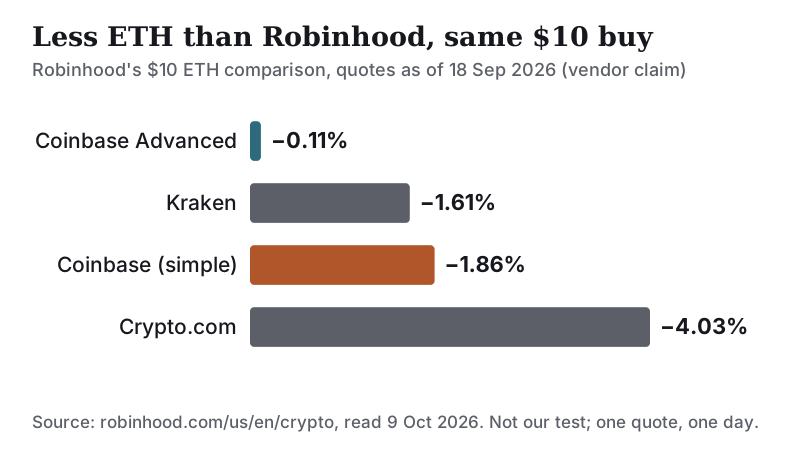
The only side-by-side figure available comes from Robinhood itself, so read it with that in mind. Robinhood's crypto page shows a third-party-verified quote comparison as of 18 September 2026; the table it displays is for a $10 ETH purchase. Against Robinhood's quote, Coinbase's simple buy delivered 1.86% less ETH, while Coinbase Advanced delivered only 0.11% less. Kraken came in 1.61% below and Crypto.com 4.03% below.
In dollars, the gaps on that $10 order are small: about 19 cents for Coinbase's simple button and about 1 cent for Advanced. Percentages on a $10 order need not match those on a larger one, so do not multiply them up to a $1,000 purchase. One vendor's table on one day proves little about any other day, but it confirms the point that matters: on Coinbase, the screen you buy from changes your cost far more than the brand does.
Coins and products
Robinhood began as a stock broker and treats crypto as one tab among several. Its crypto page lists recurring buys from $1, staking of ETH, SOL and ADA from $1, and a self-custody wallet. Its fee schedule shows a 25% commission on staking rewards, which is the number to weigh against any rate you see in the app. Robinhood does not publish a coin total on its marketing page, so check that the specific coin you want is listed, and transferable, before you open an account.
Coinbase is a crypto exchange first. Its 2025 annual report describes an "everything exchange" that by December 2025 also offered stocks, commodity futures, perpetual futures and prediction markets, alongside its spot crypto markets. For a buyer who only wants bitcoin, that breadth adds nothing. For someone who wants an order book with limit orders, the Advanced screen is the reason to choose it; for a less common token, check both apps, since listings differ and change.
One practical difference is easy to miss. Coinbase Wallet, the company's self-custody app, is not the same thing as your Coinbase exchange account. Robinhood's wallet is likewise separate from Robinhood Crypto. In both cases, coins in the main app are held by the company; coins in the wallet app are yours to control.
Withdrawals to your own wallet
This used to be the deciding factor, and it is the one most older comparisons get wrong. Robinhood now lets you send and receive crypto. Its fee schedule says Robinhood charges $0 to send or receive, though the blockchain's network fee still applies, and its help pages say transfers are available in every US state. Withdrawal limits vary with your verification level and account history, and some tokens cannot be transferred in New York.
Coinbase also lets you withdraw to an outside address. It charges a network fee based on its estimate of current network costs, shown before you confirm, so we give no fixed figure. Sending bitcoin over the Lightning Network from Coinbase carries a 0.2% processing fee instead.
The upshot is that neither app traps you any more. If you plan to buy and then move bitcoin to a hardware wallet, both will do it; check the minimums and fees on the confirmation screen before you send.
Transferring crypto between the two apps
To transfer crypto from Coinbase to Robinhood, you send it like any on-chain payment: copy a receive address from Robinhood and paste it into Coinbase's send screen.
- In Robinhood, open the coin you want to receive and choose the option to receive it. Copy the address, and note the network it names.
- In Coinbase, choose Send, pick the same coin, paste the address and choose the network Robinhood named.
- Try a small test transfer before the full amount, and wait until Robinhood shows it as received.
- Check the network fee and the final amount on Coinbase's preview screen, then confirm.
The direction can be reversed the same way. Two things go wrong most often: choosing a different network on each side, and sending a coin the receiving app does not support. Either can lose the funds, which is why the test transfer is worth its small network fee. Robinhood's receive limits also vary by account, so a large first transfer may be held for review.
Safety: custody, regulation, incidents
Neither app is a bank account for your coins. Coinbase's annual report says crypto held for customers is not insured or guaranteed by any government agency; only US dollar cash may sit at FDIC-insured banks. It says it holds customer assets one-to-one and aims to keep no more than 2% in hot wallets. It also warns, in its own risk factors, that courts have not tested its custody terms in a bankruptcy, and that customers could be treated as general unsecured creditors. That is the honest risk of leaving coins on any exchange.
On regulation, the picture is cleaner than older articles suggest. The SEC dismissed its civil case against Coinbase on 27 February 2025. Both firms hold New York virtual-currency licences on the NYDFS list: Coinbase since January 2017, Robinhood Crypto since January 2019.
On incidents, Coinbase disclosed in May 2025 that bribed overseas support staff had taken customer data. Passwords and private keys were not exposed, and the insiders could not move funds, but the data fuelled impersonation scams. Coinbase's 2025 annual report says it paid $311.2 million in cash that year on reimbursements and legal costs. The lesson applies to both apps: no real support agent will ask you to move coins to a "safe" wallet.
Availability in the US and abroad
Robinhood's transfer feature covers every US state, per its help pages, and Robinhood Crypto is licensed in New York. Coinbase also holds a New York licence. If you live in New York, check each coin individually: under New York's coin-listing rules, some tokens are unavailable there or cannot be transferred out.
Outside the US, Coinbase is the one this page can speak to: ESMA's register lists Coinbase Luxembourg as a MiCA-authorised crypto-asset service provider since 20 June 2025. This comparison covers Robinhood's US app only, so if you live elsewhere, check what Robinhood offers in your country directly.
Who should pick Coinbase
Choose Coinbase if crypto is the reason you are opening an account. You get an order book through Advanced with limit orders, a separate self-custody wallet product, and an EU-authorised entity if you live there. Learn the Advanced screen before your first large order; on Robinhood's own figures, it is where Coinbase competes on price. Avoid the one-tap buy for anything but small, deliberate amounts.
Affiliate link. We may earn a commission if you sign up — it never decides who wins a comparison. Check current terms and eligibility in your country.
Who should pick Robinhood
Choose Robinhood if you already use it for stocks and want a small crypto position without a second login, or if you want recurring buys from $1 with no commission line. Remember that the cost sits in the spread, about 95 cents per $100 on Robinhood's own June 2026 example. Do not switch on exchange routing expecting a discount: under $10,000 of monthly volume, it costs more.
If you are still undecided, the wider crypto exchange comparison explains how we weigh fees, custody and region, and Coinbase vs Kraken shows how Coinbase stacks up against another dedicated exchange.
Edge cases worth checking first
- You live in New York. Both firms hold New York licences, but coin lists and transfers are narrower there. Check your exact coin.
- You want to stake. Robinhood keeps 25% of staking rewards; Coinbase's standard commission is 35% on ETH, SOL, ADA and several others, lower for paying Coinbase One members. Compare the net rate, and remember unstaking can take from minutes to weeks.
- You trade often. Robinhood's exchange routing starts at 0.95% taker. Coinbase Advanced prices by 30-day volume or account balance and advertises maker fees as low as 0.0% at its top tiers; check your own tier in the app.
- You hold a lot on one platform. The bankruptcy wording in Coinbase's own filings applies to any custodial app. Keep only trading balances on an exchange.
- You received a "support" call or text. Hang up. Contact the company through its app, never through a number someone sends you.
Crypto prices can fall sharply, and every dollar you put in is at risk. Nothing on this page is financial, tax or investment advice.
Coinbase vs Robinhood: quick answers
Is Robinhood cheaper than Coinbase for crypto?
Can you transfer crypto from Coinbase to Robinhood?
Can I withdraw bitcoin from Robinhood to my own wallet?
Robinhood or Coinbase for a beginner?
Is my crypto insured on Coinbase or Robinhood?
Still deciding? See how to compare crypto exchanges for the full method, or browse every head-to-head. None of this is financial advice.